
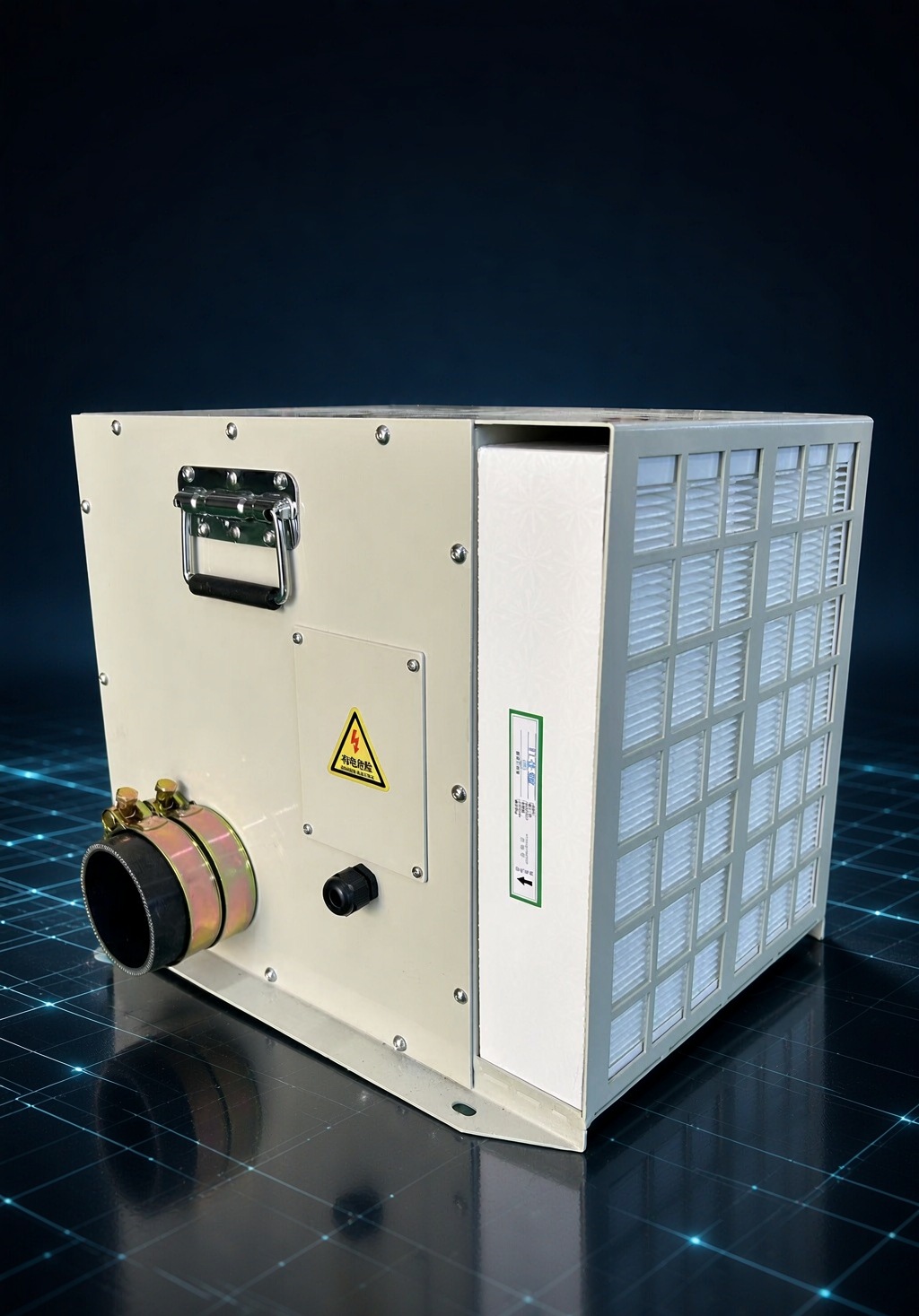
**Short answer:** for the same airflow and pressure duty, a high-speed turbo blower (permanent-magnet, direct-drive) typically draws **40–60% less electrical power** than a Roots blower or a regenerative (side-channel) blower of equivalent output. On a measured retrofit in a 3C glass cleaning line, one 2.2 kW turbo blower replaced two 3 kW conventional blowers and cut the monthly electricity bill from **CNY 1,891 to CNY 818 — a 57% reduction, with a 9-month payback.**
This article breaks down why the gap is that large, where the numbers come from, and how to check whether your own blower is a candidate.
1. Why the three designs differ so much
| Roots (positive displacement) | Regenerative / side-channel | High-speed turbo blower | |
|---|---|---|---|
| Working principle | Two lobed rotors trap and push a fixed volume of air | Impeller accelerates air in and out of the same channel repeatedly | High-speed impeller gives air one pass of kinetic energy, converted to pressure in a diffuser |
| Typical speed | 1,000–3,000 rpm | 2,900–3,600 rpm | 15,000–24,000 rpm |
| Drive | Motor + belt or gearbox | Motor + direct or belt | Permanent-magnet motor, direct drive, no belt/gear |
| Efficiency at part load | Poor — fixed displacement, throttled by valve | Poor — fixed speed, throttled | Good — VFD controls speed, power follows demand |
| Oil in the air path | Often present (gear/bearing lubrication) | Usually none | None — ceramic ball bearings, oil-free |
| Noise | High (pulsation) | High (broadband) | 78 dB(A) at 1 m with enclosure, measured |
The core of the energy gap is not one component — it is the **combination of a high-efficiency permanent-magnet motor (94%), no mechanical transmission loss, and the ability to run at part load**.
A Roots blower is a fixed-displacement machine. If your line only needs 60% of the design airflow at a given moment, the blower still moves its full displacement and you dump the excess through a relief valve or throttle. A turbo blower simply slows down: at 60% flow it draws roughly 60–65% of the power, not 100%.
2. Where the numbers come from
The figures in this article are not catalogue estimates. They come from a **one-week continuous measurement** on a customer line (referred to here as Customer A), a 3C glass AOI inspection and cleaning station.
| Item | Before: 2 × conventional blower | After: 1 × high-speed turbo blower |
|---|---|---|
| Rated power | 2 × 3 kW | 1 × 2.2 kW |
| Measured running power | 2.11 kW each | 1.82 kW |
| Discharge pressure | 20 / 26 kPa | 57 kPa |
| Airflow | 420 m³/h each | 600 m³/h |
| Speed | 2,940 / 2,910 rpm | 18,000 rpm |
| Noise | 83 / 85 dB(A) | 75 dB(A) |
| Daily consumption | 48.48 kWh each | 41.93 kWh |
| Monthly electricity cost | CNY 945 each → **CNY 1,891 total** | **CNY 818** |
| Annual electricity cost | **CNY 22,691** | **CNY 9,812** |
| Saving | — | **57%**, about CNY 12,900 per year |
| Payback | — | **9 months** |
Conditions: tariff CNY 0.65/kWh, 22–23 hours per day, 30 days per month.
Two things are worth noting beyond the electricity number:
- One turbo blower replaced two conventional units and still delivered higher pressure (57 kPa vs 26 kPa) with more airflow (600 vs 420 m³/h). The comparison is not "same machine, less power" — it is "fewer machines, better drying performance, less power".
- Quality did not change. Over the test week, AOI yield showed no measurable difference versus normal mass production, drying was complete, and final inspection found no water marks or white-spot contamination.
More retrofit data: see our [customer cases](/en/cases/).
3. When a turbo blower is the right replacement — and when it is not
**Good candidates:**
- Continuous duty of 16–24 h/day (the payback maths only works with high running hours)
- Constant-pressure air-knife drying, where the process needs stable pressure more than huge flow
- Lines where the current blower runs throttled or bypassed most of the time
- Clean or lightly dusty air (an inlet filter is fitted as standard)
**Think twice if:**
- Required pressure is above roughly 35–40 kPa at high flow — check the <a href="../../../en/products/">model curve</a> before committing
- The duty is highly variable with long idle periods at very low flow (a smaller unit plus receiver may be better)
- The air source must be absolutely oil-free <b>and</b> the ambient is extremely corrosive — in that case discuss material options
4. How to size it in 5 minutes
You need three numbers from the existing installation:
- Airflow (m³/h) — from the nameplate, or measured
- Pressure at the air knife (kPa) — from the knife specification or a gauge
- Actual running hours per day, and the local electricity tariff
Then: `annual saving ≈ (old measured kW − new kW) × hours/day × 365 × tariff`.
If the measured power of the old unit is unknown, use the nameplate kW × 0.75 as a rough estimate for a Roots blower and × 0.7 for a regenerative blower. Measuring with a clamp meter for one shift is far more reliable than guessing.
5. FAQ
**Does a high-speed turbo blower need clean, dry air?**
No external air supply is required. The bearings are ceramic ball bearings, not air-foil bearings, so there is no air film to maintain. An inlet filter (replaced every 1–3 months) is all the routine attention required.
**How loud is it really?**
78 dB(A) measured at 1 m, with the acoustic enclosure fitted and ducting connected — not a free-standing open-inlet measurement. Our retrofit case measured 75 dB(A) on site, down from 83–85 dB(A).
**What is the difference from an air-bearing (air-foil) turbo blower?**
Both are high-speed direct-drive machines. Air-foil bearings need a clean air supply to build the air film and are more sensitive to start-stop cycles; ceramic ball bearings avoid that dependency and keep maintenance simple. For dust-and-humidity environments such as cleaning lines, the ball-bearing route is usually more forgiving.
Check your own line
Send us the airflow, pressure, running hours and the current blower model, and we will return a comparison table with estimated annual saving and payback — usually within one working day: [talk to an engineer](/en/contact/).